Bongo memories,lockdown blues, future plans

Winter time is still adventure time….looking forward to travel restrictions easing!

This time of year is often for me a time of reflection. I suppose that as you see the year slipping away, drawing toward the end of the calendar, it’s natural to kind of take stock, and make future plans and promises to yourself. It’s certainly been an exceptional year!

Our first Bongo adventure, October 2018.

It’s unreasonable to compare what you have achieved in 2020 to previous years, for the obvious reasons. But, I suppose I have to confess I haven’t achieved all I could even under the circumstances we have endured. The weather, right from the beginning of the first Lockdown, was superb. It must have been one of the driest Aprils for a long time, and May was glorious. But I really struggled with motivation. I found myself, like many I guess, looking at all the things I was being deprived of – my rugby refereeing, getting out in the Bongo, the long-planned multi-day trek with my eldest son at Easter time, as well as gyms closing, and shopping becoming just a chore, with queues and masks. It felt to me like we were serving some kind of sentence, a pennance, that would eventually end, normality would resume, and we could get back to living. Wrong!!

I developed a bit of enthusiasm, helped greatly by the “Indoor / Outdoor Easter Camp” facebook group – a brilliantly positive bunch who decided to just camp where they could. People were making the best of a terrible Easter holiday by camping in their gardens, sleeping in their campervans and caravans in their driveways, even camping indoors if they didn’t have gardens, or tents, but the sense of sharing was very real, and everyone was so positive, I confess I needed the help, and so I camped on numerous occasions in my Bongo, in the driveway, mostly on my own, but a couple of times with either one of my sons for company. I’m very grateful to this group, for helping preserve my sanity over the worst few months.

May time tinkering, everything rust treated and painted, new lights, perfect weather.

And so, my enthusiasm slowly grew into action. I started using the spin bike a bit more. I did some HIIT sessions when it wasn’t too hot, and my desire for something to get up to became focused on some tinkering with the Bongo. The wheels came off, and everything got cleaned and rust treated, plus a couple of generous coats of underseal. The front end got stripped down, and repainted, wiring tidied up, and some rather natty new “angel eye” foglights got fitted while the bumper was off. I even fabricated front wheel arch rubber “flaps” to prevent spray and mud flying into the rear of the new lights ( I’m quite proud of that wee invention!) so keeping everything clean and dry. The exhaust back section got repainted, the tail lights got an overhaul, and a dozen little jobs in the interior. My enthusiasm grew further – it was time for a full deep-clean interior valet, and I spent about 3 days cleaning blinds, carpets, headlining etc. I refitted interior trim that was creaking or rattling (a real pet hate of mine!) and the van was looking awesome inside!!

Interior deep clean, blinds scrubbed and looking like new!
A 2 day exterior detailing as well

So many little jobs were getting done, and it’s really only on reflection now that I realise what I got done. The issue of extra storage for the bedding addressed by fabricating a storage area inside the seat, in the dead space inside the seat back, accessed by hinging the back part of the seat ( this particular problem had been in the “design stages” since first buying the van!), and then finally the construction of my new kitchen pod. There were lighting modifications in the interior as covered in my previous post.

Finally a storage solution for our bedding! King size sleeping bags, four pillows and a fitted sheet, all stored where previously was a void space.
The kitchen pod in final assembly, it’s become a really valuable and useful addition to the Bongo

We finally got away, although by now it was July, but as the restrictions eased and travel was allowed, we booked up a few nights away at Moffat, a favourite campsite, and close to some friends of ours who live in Ecclefechan, allowing a visit and catch up with them. The campsite staff were working hard to keep everyone safe, with extra cleaning of facilities, and social distance signs everywhere. It was just great to get out, to visit one of our favourite spots, and to forget the Covid nightmare for a few days.

And there was the small matter of an MOT to be done. I had previously used DialaMek in East Kilbride, and I contacted them to arrange some suspension refurb work (new front struts and bushes, wheel alignment) along with a service and MOT. This was carried out in early August – and the Bongo passed with flying colours, no advisories at all!! Some small bits of tinkering under the seats in the engine room too, and the annoying oil leak from the rocker cover bolts addressed. The Bongo really was in great shape, inside and out, as well as mechanically, we were in the best shape this van has been in for many years!

Worthy of mention are the Bongos, brews and Blethers fraternity!! We did manage to get two meets this year, one back in pre-lockdown winter, and one in September just prior to further and tighter restrictions imposed. Fellow Bongo owners, it’s great to meet and gab with you all, and to see so many different van layouts, and such clever and innovative ideas, there really are nicer people met through owning a Bongo, folks!!

Bongos everywhere!!

And then, work got in the way. For large parts of August, September and October I was working in far-flung corners of Scotland, and I was too busy trying to make sure the equipment we work on was doing as it should to get any time at all with the Bongo. There was more bad news on the rugby front – the season was completely scrapped, so no games for a referee. I was getting depressed again, and the weather was turning wetter, the days shorter. It felt like the summer had passed us by, and I had only managed two nights away! Covid really sucked!!

I was determined to get a proper trip organised. Something we would remember.

Silver sands at Ardmair, stunning, wild, perfect.
Dunvegan bay, Skye, glorious in the autumn sunshine
Over the sea to North Uist
North Uist
Balranald Reserve, North Uist
Harris
Sunrise over the bay, Lickisto, eastern Harris
Tarbert, Harris
Ness, Lewis
Iolaire memorial, Stornoway, Lewis

And so, with a trip to Stornoway for inspiration, I hatched an ambitious plan to visit the Outer Hebrides during the October break with Lorraine. This was a special year for us, being our 25th Anniversary, and while it had been a traumatic year so far, I was determined to make some happy memories for us. As detailed in the posts of our trip, careful planning of ferries and campsites allowed us to have an absolutely fantastic trip, visiting Skye, North and South Uist, Lewis and Harris, by way of five ferries in six days. We covered over 850 drama-free miles in our 25 year old Bongo, sleeping in a different spot every night and seeing some incredible scenery.

And as a final Anniversary surprise, I arranged to stay at Solway View Campsite, near Kirkudbright in South West Scotland (another favourite). I managed to sneak our two boys into the celebrations, as well as our dear friends Kath and Heather who came all the way from Ecclefechan to help us celebrate. Other than the terrible storm on the Friday night, which sadly trashed our friends’ awning, it actually turned out a great weekend, and the site owners were extra kind enough to give us a lovely bottle of wine.

Firepit marshmallows, good company, whisky and banter for our 25th Anniversary
Coastal walks nearby make Solway View a brilliant weekend getaway

So, despite feeling utterly depressed about not being able to just “get up and go” as the old adage goes, when I look back and reflect on 2020, it has actually had some real high lights and high points, and despite the odds, we have managed probably better than a dozen nights away together. We’ve had our breath truly taken away by some of the most stunning scenery Scotland has to offer – endless white beaches, rugged coastlines, quiet lochs and majestic mountains – and we are more in love with Bongo Life now than ever. Over the course of 2020 we’ve continued to improve the van, made some lasting friends and memories, and been down many a “road less travelled” in Ali Bongo.

With the vaccine being rolled out, a sense of hope and an end to the restrictions is perhaps not far off. Although what we took as normal might not return for a long time to come, we can still look forward to getting out and about again. I still have places to visit, and this amazing country just inspires.

I want to thank everyone who has come on this journey with me so far. Anyone who has taken the time to read a blog post or two, I hope you have been inspired to visit some of the places in Scotland I have written about, and I hope I have at least given you something to ponder around how you use your own campervan. Perhaps even given you some ideas of modifications to carry out yourselves? If I’ve helped keep your spirits up slightly, then that’s a bonus. Thanks for coming with me so far, and I hope I can have your company in 2021! Cheers!!

Sunset, North Uist

Enlightened Lockdown Modifications

Footwell lighting, part of the upgrades fitted

I have highlighted some of the upgrades I carried out while sitting out the frustration of Lockdown, unable to get away in the Bongo. There was an overhaul of the slam panel up front, a bit of undersealing in the wheel wells, and the “Angel Eyes” led lighting upgrade up front as well. And, having had the experience of ambient lighting in the footwells of a few recent cars, I decided to fit this while I was carrying out the front lighting upgrades anyway, as some of the work could be used for this purpose as well. I would pick up a supply from the side lighting circuit under the dashboard ( this circuit is the one available at the back of the stereo for illumination / dimming), and take it to a series of switched circuits and relays, using some of the blanks in the dashboard.

Option foglight switch, now brings on my new led front lights
Before the leds can be used, this switch brings on the “halo” lights up front, together with the ambient lighting

I decided to go with a green led strip for the ambient lighting. The van is green, and this shade makes for a strangely soothing, soft glow in the footwells and rear of the van. I wanted to keep it optional as well, but decided to share the switch with the halo lights. So, once the side lights are on, power to the switch gives the option to use halos and ambient light. A further switch after this stage gives the led foglights. This keeps the load for all these extras off of the main wiring, and powered from my new relay setup, tucked under the bonnet up behind the engine battery.

New relays with fused supplies, power for ambient lights, halos and led foglights.

The bulk of the job was the manufacturing and fitting of the aluminium plates I made for the led lights in the bumper. My Bongo hadn’t got the optional foglights, so none of the wiring was there, but it did have the blanks removed from the bumper, and a sort of mesh grill fitted. So, while the bumper was off for the slam panel overhaul, I took the opportunity to fit the foglights. It was far from simple – the holes in the bumper are actually swept backward on an angle, which would mean if the lights were fitted with the plate angle, they would be very splayed, and not really light the road where I wanted – not to mention annoying oncoming traffic!

Halo lights now optional when side lights are on. LED foglights a further option on another switch

The importance of fitting new supplies for any additional lighting load can’t be over emphasised, as the circuits and switches in the bongo were designed for what they originally fitted, no more, no less, and the wiring isn’t any bigger than needed. So, any extra load will cause voltage drop, as well as possible overloading fuses. This way, with a fresh supply and fuse from the under-bonnet fusebox feeding my relays, I can control what I connect to the original circuits, and the load of a small relay is safe enough.

So, in the front footwells, I have now got a green ambient light and in the rear, under the front of the bed as well.

Ambient light in the rear, from under the seat front edge, let’s you see the floor at night.

I also fitted a seperate set of white led strips in the back under the edge of the seat, powered off the leisure battery, for use when parked up. When we’re sitting chatting, or watching a movie, this “indirect” light is cozy, lets you see the floor, and there’s enough back light from it to see your glass sitting on the table. I have downlights above the table and at the head of the bed for other times, eg cooking or reading in bed.

Seperate circuit from the leisure battery supply is this footwell lighting in the rear, a nice indirect light when sitting parked up.
LED foglights are nice and bright, but not dazzling for other road users. Early warning of roadsigns and a good view of the verge in poor visibility

Other additions include the step light I fitted. This has made a huge difference, making seeing the step in the dark much better, and we’ve found that with the door open, this light is enough to see by at the side of the van under the canopy as well. I connected into the supply for the 12v power outlet in the rear, drilled a hole in the plastic step moulding at the closed end of the step next to the seat, and fitted an isolating switch, so that I can switch it off if sat with the door open during the day. I connected the earth through the door switch in the pillar, so the light comes on when the door is still ajar. Ideal!

Light illuminating the step when the door is opened, connected to the door switch and with an isolating switch.
Nice ambient glow in the passenger footwell.

None of these modifications are particularly expensive, or difficult to do if you take your time. The led lighting strips are fantastic, available from Ebay and other places, and come with self adhesive tape on the back. They use very little power, and last a while too, so shouldn’t need replacing. The downlights are household type standard 12v DC ones which you might use in a kitchen with a dc power supply off the mains. And the dashboard switches are available used for a few £s from the likes of Bongo Spares, or any car breaker that has a Mazda Bongo. I would estimate that the wiring, switches and relays, led lights and foglights, together cost less than £50. But I hope you agree the upgrades add to the useability and the ambience of the van.

Thanks for reading this far, I hope I’ve inspired some Festive Season projects?

Happy trails!!

LED strip middle left of picture, on L-shaped bracket and facing downward behind the glove box (removed for the installation)
Reading lights, fitted into the holes where the blanks are fitted that allow access to the fixings for the AFT, perfect position!

Lockdown Kitchen Pod Project

Ever since our first trip away in the Bongo, I’ve wondered if I could come up with a compromise kitchen pod. I needed the eventual solution to be the best possible compromise of work space, storage, portability and space saving. Was it even possible? Well, it took me most of the two years I’ve owned the Bongo, plotting and scheming, trying to come up with something that would tick the boxes, AND be something I could build with my limited woodworking skills! Take a look, and see if you think I pulled it off!

Normal position for the water container up to now, up in the roof

Anyone who has read earlier posts here will know my normal position on cooking when camping – avoid it at all costs! Both my better half and myself are content to “break our fast” on a cuppa or two and, for example, a muffin, or a few biscuits. Then, we would set off and on our travels find ourselves a cafe or snack wagon for a filled roll, or sit in for a nice cooked breakfast. It’s nice to treat yourself when out and about, doesn’t cost that much (less than a tenner a head), and it helps local business. A win all round! Oh, and most important…. no washing up! We also use the wide range of dehydrated expedition meals available for an easy evening meal. Costing around a fiver a meal, they are very tasty, filling and balanced nutritionally, as they were designed for keeping the Armed Forces and expeditions going. These just need boiling water added, and you eat them straight out the packet – you can see the no washing up theme here too!

A simple camping stove, which packs away when not in use fulfills the water heating requirements when no hookup available

So, for the majority of the time, all we need is hot water, cups, kettle, tea, coffee, sugar, powdered milk etc. Additionally, when on campsites we use an electric hookup to provide mains electricity, allowing for an electric kettle and small convector heater to be used, so we don’t even unpack the gas stove. When on these campsites, I use a plastic filing box, which holds our kitchen bits n bobs, as a little shelf for the kettle and cups. This box sits perfectly, if a little unsteadily, on the Dickie seat behind the driver’s seat, leaving the floor clear. This means that when using the rock n roll bed, with the table folded up out the way, the kitchen area can be used by whoever gets up first in the morning. It works, but being me, I wanted something that worked better than a filing box. More work surface. More storage. And, perhaps somewhere for the water container and portable fridge to live? Could it be done and still leave the floor clear?

Well, maybe…..

Obscured by the table, kitchen box is under the kettle, perched on the Dickie seat.
Kitchen kit carried in a plastic filing box, used as a shelf for the kettle
Dickie seat behind the driver’s seat, makes a handy shelf off the floor.

So, after a pre-lockdown trip on my own into the Galloway Forest, I reckoned I had an idea. If I replaced the Dickie seat with a removable shelf of some kind, it would be stable enough to rest a small unit on. My plan was to build a support, attach it to the mounts where the Dickie seat bolts in. Then make a shelf with a “lip” that would tuck behind this support, and wedge under the rear edge of the driver’s seat. This would ensure it couldn’t tip off, but wouldn’t need any fasteners. Simple! Well, it wasn’t THAT simple, not for me, anyway! After a couple of prototypes, I had a solution….

Support fitted, covered in auto carpet.
Stage two – the shelf, wedged under the trailing edge of the driver’s seat and hooked behind the support.

The pod itself wouldn’t be straightforward either. I wanted it to hold the water container we used, and my little fridge, as well as having storage equivalent to the kitchen box we would leave behind. It would have to fit between the engine tunnel and the side of the van, and lastly had to fit while travelling on the floor, under the height of the table. This would take some frustrating measuring and head scratching! I decided that as I only had one sheet of the finished material available, and that I didn’t trust myself to build this thing first time, I would buy some MDF sheet to use and build a prototype. That way, if it needed “tweaking”, it wouldn’t mean scrapping my precious board. This was a waterproof, Paxoline-type material, the same stuff I had used for the table, so it would match nicely if I pulled this off. Better to build twice than scrap my good material!

A prototype pod, built from MDF and old bits of chipboard.

Much cutting and measuring, screwing and glueing later, I had something that actually worked! I was feeling quite smug now, this was working out nicely. I also had the measurements of the final “working” prototype to use on my finished article.

I set to work on the next dry weekend,

I had bought some new thicker MDF to use for the internals of the pod, glued everything together for strength, and, assembling from the top downward allowed for the fitting of the fridge supports to hold it in place. I next worked out how to use the plastic tote tray I had repurposed as a drawer under neath. I fitted some stops to keep it in place when in transit, then carefully fitted a drawer front made of my grey board, complete with handle, I test assembled everything, then carefully masked off and painted all the MDF grey to match the finished board sides, top and drawer front. Once dry, I completed assembly with the fridge in place, and tried it in place in the van….

Building in stages, the finished pod pieces,
Test assembly of the base
All the pieces assembled prior to painting
Drawer front and fridge fitted.
Kitchen kit stores in the drawer nicely. Water container in place beside fridge.
Shelf stores in the back, nice and neat.
Retaining strap, snap studs onto the support strip for the four-way socket block.
From the driver’s side, showing the snap studs clipped on. Pleased with this solution
The finished pod, in situ, kettle shows how much room is available on the worktop.

I’m happy with the finished article, and after our Island Hopper trip, we found the pod a pretty good compromise between having an actual kitchen unit, plus keeping as much floor as possible, and being able to use our fabulous full width rock n roll bed as before. It sits nicely under the table in transit, meaning we can jump in the back and sit as before too when out and about. Everything we normally kept in that kitchen box stores in the drawer I made underneath the fridge, so we have saved a bit of space there too, plus the water container can live in the pod too, making a bit more space on the rear shelf for our luggage. True, it is a bit of a lift up onto the support shelf, as the unit is pretty chunky / heavy, but it is a once a day lift, and I can live with it for the advantage of having a nice usable kitchen space. I can still sit on the end of the bed with my feet on the floor too, which was a prerequisite of the design.

So, it turned out easy enough – it only took two years, dozens of hours of staring at the available space, many hours of cutting, and throwing away, trial pieces to build a working prototype, and the nerve-racking one-time-only cutting of my precious, irreplacable board in the finishing stages…. But, hopefully it will serve for years to come and make living in the small space inside Ali Bongo just a wee bit more comfortable.

Thanks for reading, and I hope you are inspired to have a go at adapting your Bongo living space to better suit your requirements!

The Road to the Isles – The Route Map

Our incredible trip round the Outer Hebrides was months in the planning, and because I wanted everything to go as smoothly as possible – bearing in mind this was an Anniversary / holiday trip, and our only real holiday this year – and due to the time constraints of annual leave, it would take a bit of organising! The first seeds of the plan came to me due to having visited Stornoway in early July for a work trip. It was a beautiful part of the world, and an evening drive round the landmarks of Lewis gave me the idea of a week long trip in the Bongo.

I started to research the ferries, and poured over the timetables. Some routes had only one or two sailings per day, often being really early, or mid day. I decided to opt for the mid day sailings where possible, giving us a leisurely morning if we wanted to be lazy, or time to explore if we felt up to it. The CalMac website has a bewildering variety of Island Hopper options, but eventually I settled on what I though was achievable in the time available. I wanted to start the trip on the Sunday, giving us time to pack the van, provision the house for the boys while we were away, catch up with laundry etc ( okay, all Lorraine’s department, but I wanted this to be as stress-free as possible!). I also wanted to be home on the following Saturday, to allow us to prepare for returning to work. We have had a pretty stressful six months, with the Pandemic dominating life for everyone, and I really wanted every detail of this trip to work like clockwork. So, seven days, six overnight stops. What was possible?

https://www.calmac.co.uk/island-hopping

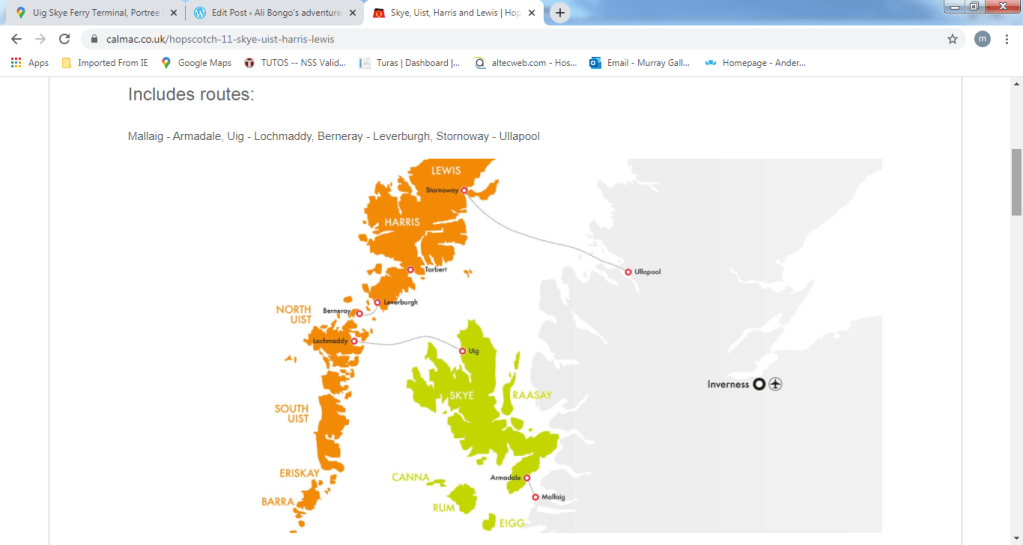
There are a wide variety of Island Hoppers available. I wanted to visit the Outer Hebrides, but I fancied Skye as well. I settled on Route 11…

This gave us four ferries – Mallaig to Armadale, Uig to Lochmaddy, Berneray to Leverburgh, and finally Stornoway to Ullapool. The tickets for this were not too unreasonable, and for two adults and the Bongo it totalled around £153.

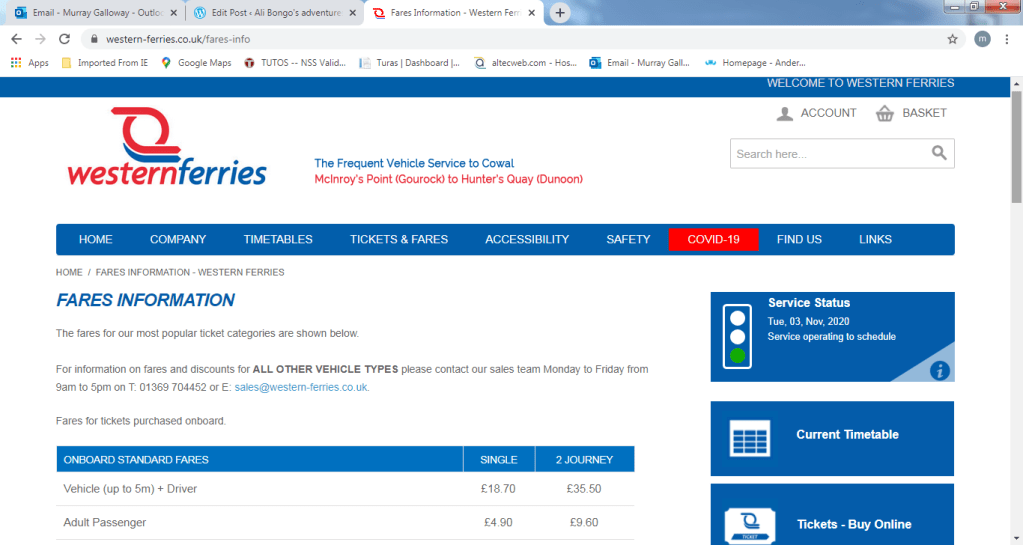
I then hit on the idea of adding another novelty to the journey to Arisaig. I am not too fond of the long drag up Loch Lomond-side and we have used the A82 to Fort William countless times. It is a beautiful road, but always really busy, and this was all about “getting away from it all”, for a week at least, trying to avoid the busiest places. And so, I came up with the alternative that would add yet another ferry, and some roads we weren’t that familiar with. I decided to book up the Western ferries sailing from McInroy’s Point near Gourock to Hunter’s Quay, near Dunoon in Argyll. This would also give us a total of five ferries in a seven day trip! The tickets were for any sailing, and it wasn’t possible to book a specific sailing. It cost around £25 for this crossing, a bit steep, but I booked up anyway, as I wanted to use the quieter roads from Dunoon to Inveraray and beyond to Connel. It was worth it!

https://www.western-ferries.co.uk/fares-info

Island Hop Details

DAY 1 – Sunday 11th October

Home to Mallaig ( Arisaig). Approx. 175 miles.

Camusdarach Camping, Arisaig.  01687 450221 £30.00

http://www.camusdarach.co.uk/

DAY 2 – Monday 12th October

Arisaig to Mallaig (Ferry)to Armadale –  WX12345 – 12:00 check-in, sails at 12:45

Armadale to Dunvegan. Approx. 70 miles. – CO-OP in BROADFORD!!!

Kinloch campsite, Dunvegan. 01470 508009 £27.00

DAY 3 – Tuesday 13th October

Dunvegan to Uig ( Ferry) to Lochmaddy – WX12345 – 13:00 check-in, sails at 14:00

Dunvegan to Uig – 30 miles approx.

Lochmaddy to Balranald – 20 miles approx. – Co-op in Sollas!!

Balranald Hebridean Holidays. 01876 510304, 07748 267996 £20.00

Hougharry, North Uist HS6 5DL

DAY 4 – Wednesday 14th October

Balranald to Berneray – 25 miles approx. Ferry to Leverburgh WX12345 14:30 check-in

Sails at 15:30, 1hr approx. Leverburgh to Lickisto Blackhouse 20 miles approx.

Lickisto Blackhouse Camping, Lickisto, Harris. 07968 951314 HS3 3EL £25.00 Pay on arrival.

DAY 5 – Thursday 15th October

Lickisto to Stornoway / Lewis – 80 miles approx. – CO-OP STORNOWAY! (NB we ended up doing considerably more miles than planned, and visited Callanish, Carloway, Garenin, Port of Ness as well as Stornoway)

DAY 6 – Friday 16th October

FERRY – Stornoway to Ullapool WX12345 13:00 check in, sails at 14:00 – 16:30

Ullapool to Grantown on Spey – 95 miles approx.

Grantown on Spey Caravan Park – 01479 872474 PH26 3JQ. £27.00

DAY 7 – Saturday 17th October – Grantown to Home, 190 miles approx.

SUMMARY

Would I do it again? Absolutely!! Our wee Bongo is the perfect vehicle for this type of trip, being small enough not to be a hassle on ferries, or narrow roads, and parking is possible anywhere you would take a car. The tank allows a decent range, and 350 miles is easily achievable between fills. Economy was good as well, with the entire 832 mile trip costing just £140, for 26.5 gallons (120.5 litres), giving 31.4mpg average, which includes at least 5 litres of fuel for the diesel heater. I might opt for some off-grid camping next time too, as there were opportunities everywhere we went, but for the use of an electricity supply, hot showers, and of course toilets, the peace of mind and comfort of campsites is worth the £25 – £30 a night spent.

Kinloch campsite, Dunvegan, Skye

I would like to spend more time in each place, and North Uist was a favourite of ours, so unspoilt, peaceful, with the most breath taking beaches either of us have seen. We were very lucky with the weather, and might have a completely different opinion if it had rained every day. But having travelled twice now in October, although obviously colder, with shorter days, the autumn is a great time to tour Scotland. Perhaps just spending the week in Lewis and Harris, so much to see and do, and we really only scratched the surface of the most obvious tourist spots. Certainly a few days chilling at Lickisto just watching the seals, and hopefully catching a glimpse of the ellusive sea otters, would be high up on my list. A truly magical place, without doubt.

Morning in Lickisto

On another trip, I might just bypass Skye, sailing from Oban directly to the Outer islands. We do enjoy Skye, but due largely to the bridge, Skye is so accessable that it has become really busy, and even in October, the campsite in Dunvegan was near capacity, with a constant procession of vehicles past our pitch into the late evening. Perhaps due to the anxieties of the current Pandemic, it just felt too busy, and the contrast with the campsites of the Outer Hebrides was marked. But, perhaps a busy campsite doesn’t matter, if the scenery of Skye is your priority, and after all, your campervan is your own private safe haven.

I hope our trip to the Outer Hebrides has inspired some readers to explore the more remote parts of Scotland, and I hope some of the detail of our trip is useful. I would use every campsite again without hesitation, but there are loads of alternatives, especially in Arisaig. Why not take a trip?

And finally, I have to yet again sing the praises of my 25 year old Mazda Bongo, Ali! What a brilliant wee van! I did spend a fair bit of time over the summer making sure he was running as well as was possible. I replaced some parts in the coolant system, I treated and painted the wheel wells, I have added some extra running lights to the front, as well as building my little kitchen pod to make life a little more comfortable when parked up. And, I got the van serviced, MOT’d and some suspension parts replaced at Dial a Mek, in East Kilbride. I tried to make sure everything was as prepared as could be. It doesn’t mean things won’t go wrong. But, hopefully it reduces the chances of it!

Thanks for reading this far. Now, go and explore the Road Less Travelled!

Bongo Adventures!

The Road to the Isles – Day Six

The Iolaire memorial in Stornoway harbour

Day six arrived. Today, we would be catching our final ferry of the trip, taking us back to the mainland, if a few miles north of where we left it back on Monday morning. The ferry from Stornoway to Ullapool would sail around 1400, so we had the morning to potter around the town before having to check in. We had slept well in the comfortable wee flat, and the shower was excellent! We had breakfast as had become the routine of this trip – a couple of cups of coffee for me, and a muffin. Easy, tasty, and enough to get you moving until we could find something more substancial. We repacked our bags and stowed them in the Bongo, a quick check round the flat before setting off.

We headed round the outskirts of the town, in the direction of the airport and beyond, to Point, an island joined to the main body of Lewis by a causeway across what would have been tidal flats and dunes. We headed to the viewpoint at Tiumpan Head, where there is a lighthouse above the cliffs, and a great vantage point to look toward the mainland over the Minch.

Tiumpan Head lighthouse, the mainland visible beyond.

It was a pleasant morning, the breeze had dropped off a bit, and the clouds were broken showing blue skies beyond. We were hopeful of decent weather for our ferry crossing, as this was going to be a two and a half hour trip. The panorama back to the mainland to the east, round to Skye and the Cuillin to our south, the views were spectacular. There is a little walled picnic area atop the rise behind the lighthouse, ideal for a summer picnic. We took in the views for a while, before heading back to the town.

Views around Stornoway

As we approached the edge of town, we came on a filling station which had a large snack wagon to one side of the forecourt.We pulled in, parked up, and bought a couple of the superb Stornoway rolls, black pudding and Lorne sausage. Absolutely delicious! The food we found on our trip was consistently good, but our favourite is the distinctly unique Lorne sausage we found on Lewis and Harris. Oh, and the Stornoway black pudding isn’t bad either!

We headed into town, parking at the harbour near the bus depot, and wandered round the streets. There were statues in the well kept public spaces, celebrating the women who worked in the fish markets. And, there was a tasteful memorial to the tragic loss of the Iolaire, lost with more than 200 souls, soldiers returning from the Great War in the early hours of January 1st 1919. She went down and broke up near the entrance to Stornoway harbour, and the loss of so many men from the island devastated the population. There is a monument opposite the harbour, as well as the recent addition of a series of piles driven into the ground just below the high tide mark in the harbour, outlining a full scale shape of the yacht’s hull in the sand. A plaque on the harbour wall lists the men lost and from which village. It’s a touching reminder of a tragic loss.The streets were bustling with life, folk were starting to look for something for their lunch, and although we weren’t hungry yet, we thought it wise to buy something for eating on the ferry later on.

Lorraine had spotted a little sandwich shop near the river, so we went there and bought a couple of sub sandwiches and home made cookies. Everything was freshly prepared, and we looked forward to eating it later.We headed back to the van, and drove round to the ferry terminal to check in, and parked up in the queue.We had a last walk round the harbour area to pass the time until the ferry arrived from the mainland. Presently, the MV Loch Seaforth berthed in the terminal and vehicles started to disembark. The seemingly endless string of cars, campervans, motorhomes and lorries snaked slowly past, and after a few minutes to allow the last of the foot passengers to leave the ferry via the long walkway, we started to board. The larger vehicles went first, to be arranged on the car deck at the open stern end, followed by most of the cars, who were destined for the large mezzanine deck. Once they were safely winched up into the upper car deck area, we began to board with the remaining cars and the other campervans and commercials. The huge ferry holds an impressive amount of vehicles. The car deck wasn’t quite full, so we had a bit of space to get out the van before heading up the companionways to the passenger decks and the outside areas.

Last views of Stornoway harbour

We reached the deck and looked out over the harbour, finding a bench in the sunshine. We stayed on deck after the ship expertly negotiated the tight berth, turning toward the mainland, and picking up speed as she left the bay behind. We sat reflecting on the incredible places we had been in just a few days. So diverse, with seemingly endless beaches, low waterlogged marsh alive with birds, mountains and rocky shorelines, high and wild moors, towering cliffs with hidden harbours, world-famous standing stones, Iron Age Brochs, blackhouses, such a varied landscape and habitat. All the campsites had been great, but the stand outs were Balranald on North Uist, and Lickisto on Harris.

Like the NC500 trip last year at this time, we found that despite the chill, the weather had actually been really kind to us. In fact, only really one rainy day when we were on Skye prevented us getting out for a walk, so heavy was the torrential downpour. It was largely sunny, too, and we were able to raise the Bongo roof tent and leave it up every night.we watched the coast of Lewis dropping into the distance behind us before heading indoors to the passenger lounge to find a table we might eat our Subs at. Lucky for us, there was a table free, so we sat and ate hungrily – the sandwiches were delicious! After a while, we began to see islands out either side of us.We took to the deck again, and were treated to the uplifting sight of dozens of dolphins cavorting in the sea beyond the bow wave. we sailed past several schools of the energetic animals, some breaching and completely clearing the water in what seems to be sheer joy in motion. We left them behind in the deeper water as we approached Ullapool. We docked right on schedule, and the announcement for “drivers and their passengers to return to the car deck”. We joined the orderly queue down the steps, climbed into the van, and after just a short time we disembarked onto the esplanade in Ullapool. We were on the mainland.

The drive to Inverness on the A835, then on to Grantown on Spey passed without incident, and although we were tight for time in the ever darkening evening, and we drove through occasional drizzle as we headed south down the A9. We arrived at our final overnight stop just as dark settled, around 1845. This large campsite is very well run, and we were met outside reception, checked against the list of arrivals, and shown to our pitch in short order. A large level gravel pitch, with it’s own hookup and a water tap just 10 metres away was a short walk from the shower block as well as the main entrance where there was a chip van parked. We had food with us, but elected for a final treat of fish and chips – well, it would be rude not to, eh?!While Lorraine went for the food, I quickly sorted out pitching up the van. we were organised in short order, and I put the diesel heater on for a while, it was getting chilly outside.

Spacious level pitch at Grantown on Spey

A movie while we ate, and we turned in early again. We were really tired after the long ferry crossing followed by the near- hundred miles from Ullapool. we both fell asleep quickly, relaxed and warm in our little van. The bed and our king size sleeping bags are extremely comfortable, and we slept well.

Grantown on Spey

When we awoke, we showered in the most fantastic showers we had found on the trip – brilliant water pressure, temperature control, and no button to keep pushing! We packed the van, then headed into Grantown for breakfast in a cafe, before heading home. We had almost 200 miles to cover, and sunshine and showers kept alternating the entire trip. We arrived home around 2pm, pulled into the driveway, switched off the engine and reflected for just a minute on our trip. This old van had performed superbly, keeping us warm and comfortable, with never a splutter the whole 830 odd miles. Just like the NC500 trip, we had truly whetted the appetite for exploring our amazing country. So much to see, such diversity, peace and quiet if you are willing to seek it out.

Addicted Bongonauts, for sure!

The Road to the Isles – Day Five

The paths wind through the trees, passing camping spots on the way to the shore

Day five saw us heading from Lickisto onwards north through Harris, to Tarbert, and on to the northern-most point on the island of Lewis at Port of Ness. We had the luxury of no ferry to catch today, and when we woke, we talked about what we might see today. I was keen to see the little secret harbour below the campsite as the sun rose, so I quickly pulled on some clothes and quietly opened the sliding door, heading down the winding path past the owner’s house and on through the camping areas and the lower blackhouse.

Lickisto Blackhouse

This house has been redeveloped inside as showers, toilet, kitchen and laundry facilities, as well as a spacious chill-out area with a log fire. In other times, this would be a really popular facility, especially with tent campers, but this late in the season there weren’t any brave souls in tents, only the campervans and motorhomes parked near us.

Good morning, Lickisto!

I reached the shore, arriving above the harbour, which is apparently of Viking origins. With the low golden sunlight slowly growing as the sun crested the opposite hillsides, it was easy to imagine a silent, menacing longship sailing up the narrow sound, to beach below me and it’s occupants stepping over the gunwhales and creeping quietly up the slopes toward the sleeping crofts above. I stood watching the rim of the sun appear and slowly rise above the hills, the water flat calm and mirror-clear. The trio of seals beached on the rocks opposite looked over with disinterest, and a lone heron silently glided up the loch before landing further up the sound to start fishing. I snapped a few photos, captivated by the peaceful scene, and almost losing track of time. But, we had a busy day ahead, so I headed back up the slope to the van for some coffee and a bite to eat. I then showered quickly in the basic, but perfectly adequate facilities in the nearest blackhouse, before Lorraine headed off to shower. I used the time to pack up the kit, having stowed the bedding back inside the seat back. It was getting easier to put everything in it’s place, as I got used to the best way of packing.

Seals, relaxing on the far shore

When Lorraine returned, I left her to dress and use the hair dryer she had brought ( a tiny travel one!)and I sat at the table next to our pitch with a cuppa.We would definitely come back to this unique and peaceful place. We completed the task of preparing the van for travelling, said goodbye to the site owner, and retraced our journey from the main A859, turning right this morning to head toward Tarbert, a port which sits centrally in Harris and where the ferry from the mainland arrives. The road wound it’s way through the mountains of this part of the island, reaching a fair height in the bealach between two peaks. I stopped for more photos. Onward, we wound downhill, past solitary crofts in the bleak landscape. Little is going to grow in the rocky and wet ground, and it’s difficult to see how the hardy souls who live here would survive in bygone days without the fishing to feed them. We reached Tarbert, as we dropped into the narrowest part of the island, only a few hundred metres wide from coast to coast. Tarbert sits in a sheltered bay, facing the mainland to the east.

Tarbert, Harris

The small town was a hive of activity, mostly due to the extensive construction going on improving the ferry terminal. The air was filled with beeping reversing alarms, shouts of the workers, diggers and forklifts moving around the site, and a massive crane lifting steel work into place as the pier is extended into the sea, reclaiming more land area. We parked in the central car park and wandered through the small town, where sadly most of the shops and pubs were closed, no doubt due to the Pandemic. We climbed higher as the street left the harbour, and came across a snack wagon near the road. The smells were very appetising, and we decided a Stornoway Lorne sausage in a roll would be very nice indeed! We soon found the the owner / chef was from east Kilbride, Lorraine’s home town, and also went to the same school! They exchanged names of friends and classmates, finding a few in common, to my surprise, what are the chances?! We took our rolls, and drinks, and found a nearby bench to sit at, but the chilly wind meant that we didn’t wait long, before heading back to the van.

With lots more to see today, we headed off on the A859, the main road north and west. We presently passed beside Loch Seaforth, a huge, winding body of water, an ideal harbour sheltering small fishing vessels which ply their trade in the loch, and out in the Minch. Although sparsely populated, there were still crofts and small houses dotted around on either side of the road. We climbed steeply again, before dropping toward Loch Erisort and a bit further on we reached the turnoff west we were looking for. The moorland around us now showed signs of peat cutting, and we now joined the A858, taking us west to the famous Callanish Stones. As we drew closer, the stones could be seen atop the hillside, and we turned off for the visitor centre and car park. There were a number of cars and campervans in the car park, unsurprising, as the stones are world-famous. We walked up the hillside to the visitor centre, noting the long queue for the toilets ( due to the restrictions of the Pandemic) as we headed toward the stones.

The Callanish Stones

There were around a dozen tourists in and around them monument, and we joined them to wander among the monoliths and wonder at the peoples who erected the huge stones. Why here? And what purpose did they serve? There is a long parallel row of stones heading off north from the main cluster, which are arranged in circular formations, with lines off pointing toward the compass points. Amazing.

Exploring the Stones

We reluctantly headed back to our van, and set off again toward our next destination, the Broch at Carloway nearby. This impressive Iron Age Broch stronghold sits on a strategically astute outcrop of bedrock overlooking the distant shoreline, lochs and farmland. This spot would be perfect to protect the surrounding lands from any intruders, who would be easily spotted at a distance. We climbed the hillside path to the ruins, which have scaffolding around part of the site while the building is being restored, and slowly circled the site. This is one of the better preserved Brochs in Scotland, and although the walls are crumbling and incomplete, the highest parts stretch to easily 5 or 6 metres high. From the low entrance, it is possible to see the twin wall construction method, and the passages in the gap between the dry stone construction. The near perfect circular footprint is impressive, as is the careful use of interlocking stones to tightly bind the structure.

The Broch near Carloway

We could have spent longer peering at the ruins, but we had other places of interest to check out, so off we set once more.

Skillful Iron Age stonework

Our next stop was at the restored blackhouse village at Garenin. This cluster of authentic and sympathetically restored houses are normally open to the public, but were closed due to the Pandemic. Imagine our surprise, then, when we walked towards the little village and came across a hive of activity. There were several vans and trucks around, and people busy unloading and stacking what we discovered were all film props for the upcoming documentary based on the novel on island life by the well known Scottish newsreader John Mackay, who was brought up in Lewis. The period style props were stacked awaiting careful placement around the village, and the film crew were busy setting up for the film crews next week. The incredible buildings were so accurately restored, looking like they must have done when the village was thriving, although it was actually still occupied in the 1980s. We will definitely look out for the film when it is released.

Garenin Blackhouses
Film props stacked ready for use

Onward again.

We set off again, northward and we reached the village of Barvas, where the road meets the direct route across Lewis to Stornoway. We were heading there later, but for now, we kept to the road north, now the A857, toward our second last stop for today. We travelled onwards, ever north, across a watery world of peat bogs and heather, further from the coast for the most part, but we caught glimpses of the sea off to our left. After a while, we arrived at Port of Ness. This is the northern most settlement, and the end of the main road. If we had time, we would have taken the short track to the Butt of Lewis, the furthest point north and west on the island, but as we were running out of daylight, we parked at the little rocky harbour, and gazed at the distant coastline of the far north west corner of the Scottish mainland, toward Scourie and Kinlochbervie, places we had visited the previous October when we toured the fabulous North Coast 500 route.It felt so strange to see the distant lands, far east of us, and it served to reinforce just how remote the Outer Hebrides really are.It was cold in the stiff breeze, and we didn’t linger for long.

Port of Ness, the mainland in the distance

We set off back south, all the way back to Barvas, where we could take the fork toward Stornoway. We travelled over 100 miles that day, and although there was so much to see, we felt we had sampled a fair bit of the islands, and it meant we would definitely return to explore further. As we reached the outskirts of Stornoway, it was getting dark, but I subtly switched on my sat nav on my phone to guide me tomy little surprise for Lorraine, the Air B and B I had booked up for the night! The campsite in town was open, but had no access to facilities, so I didn’t see it worth booking up when I couldn’t use the showers or toilets. This little flat proved ideal, very comfortable, well appointed, and great value for money. we located the apartment, checked everything was in order, then headed off to the large Co op for supplies, and on to the famous Cameron’s Chippy for some delicious fish and chips. We scurried back to the flat, to eat and watch some tv, before turning in to the comfortable bed for an early night.

What a packed day we had spent exploring Harris and Lewis. Tomorrow would see us catch the ferry back to the mainland, with only one further stop off before our trip comes to an end. We had fallen in love with the diverse landscapes of the Outer Hebrides, and it had whetted our appetites for a return visit. We would have a bit of time in the morning to explore around Stornoway before checkin for the ferry, though.

views from Lickisto

The Road to the Isles – Days Three and Four

The village of Uig, stepping stone to the Outer Hebrides

After leaving Dunvegan, we headed south and west, vaguely in the direction of Portree, but ultimately to Uig, in the next inlet on the north coast of Skye. We were in no real hurry, although the ferry check in closing time of 1pm left us with a scant few hours to explore. My default is to find an obscure route to your destination, and there was a B road which took a bit of a circuitous route, but eventually ended up on the outskirts of Portree and the road to Uig. I turned off the A863 on to the B885 over the moors. The road quickly narrowed into single track, and twisted ever upward between the steep hillsides. The colours of the ferns, bracken and heather in the autumn sunshine were spectacular, and we chatted excitedly about our first visit to the Outer Hebrides.

Rush hour on the B885!

We rounded a curve in the hills and came across a large herd of sheep! The farmer and his crew expertly herded the animals off the slopes, one on a quad, one on foot, and presumably the boss in a van slowly pushing the sheep our way. I pulled in as far as possible, and watched the men work as they approached. the sheep filed dutifully past us, and as the white van passed us, the elderly driver doffed his cap in thanks! I gave a big wave, and we set off again. We crested the moor, and now wound downhill toward Portree and the main road again. The weather was improving all the time, and although the wind was still stiff, it was backing round to the west, so the cold bite was easing. We continued on, eager to reach the port, and the sun made the hillsides burst with colour. Just over an hour from Dunvegan, we reached Uig, and parked on the shore front to explore and stretch the legs. There wasn’t much to explore, really, but the impressive pier, stretching hundreds of metres into the bay, drew me on a wander.

The pier, Uig

There are toilets in the ferry terminal building in town, so we paid a visit, before, true to form, we thought about finding food! The cafe at the pier was closed, but the tearoom in the caravan site was open for takeaways, so we browsed the menu, picked our lunch and made use of our campervan to eat. the sandwiches were freshly made and I can personally vouch for the carrot and coriander soup! After lunch, I moved the van over the road to the little filling station, brimmed the tank again for the roads ahead. I then checked in for the ferry, although we were early, and parked the van in the queue, then headed off down the pier for a look. The views back toward the village, and out between the headlands, were stunning in the sunshine. I took a couple of photos, and headed back to the van, where Lorraine was busy with her quiz book.

Uig from the ferry

Before long, the ferry berthed and emptied, the impressive procession of cars and trucks seemed endless. The ferry staff communicated to the pier staff, and we started to load. Luckily the ferry wasn’t full, and the crew allowed the vehicles to load up a bit further apart than usual on these ships. We climbed the stairway to the outer deck, found a spot sheltered from the breeze, and settled in to see how long we would brave the cold. As it turned out, we had found a perfect spot – sheltered from the wind, great views, and basking in the sunshine. We spent the entire voyage here, which was really special. The two hour trip passed in what felt like half the time, and I strained to view the approaching coastline of North Uist. Bearing in mind how far west Skye is, and the length of the sailing, Uist really did feel remote, and as it came closer, with two strangely animal shaped rocks, almost sphynx-like, guarding the entrance to the bay at Lochmaddy.

Uig and Skye in our wake
Rock sentinels guarding the mouth of the bay.

Looking forward, we could watch the ship being threaded between the small islets in the narrow bay toward the pier. We heard the announcement requesting vehicle drivers to return to the car deck, and eagerly headed downstairs. We were soon disembarking, and headed south and west on the main road from Lochmaddy, the A867. I had hatched a bit of a daft idea – I was going to drive all the way south, to the southern port of Lochboisdale, on South Uist! This would technically allow us to “tick off” both South Uist and Benbecula, as well as North Uist, in a single visit. Perhaps in hindsight, we should have spent the limited time sight seeing on North Uist, but we plan on returning next year, and this was just a bit of fun. The mountains of the east side of the island were soon behind us, and moorland stretched from horizon to horizon. We soon reached the causeway onto Benbecula, which is pretty low lying, with the sea all around in long, narrow finger inlets on both sides. In fact there seemed more water than land so far. We saw some incredible white sand beaches on the west coast as we went, and after crossing onto South Uist, we gradually climbed a few metres above sea level again, before dropping into Lochboisdale, a larger village on the southern end of the island.

The port of Lochboisdale, South Uist, a whistle stop tour

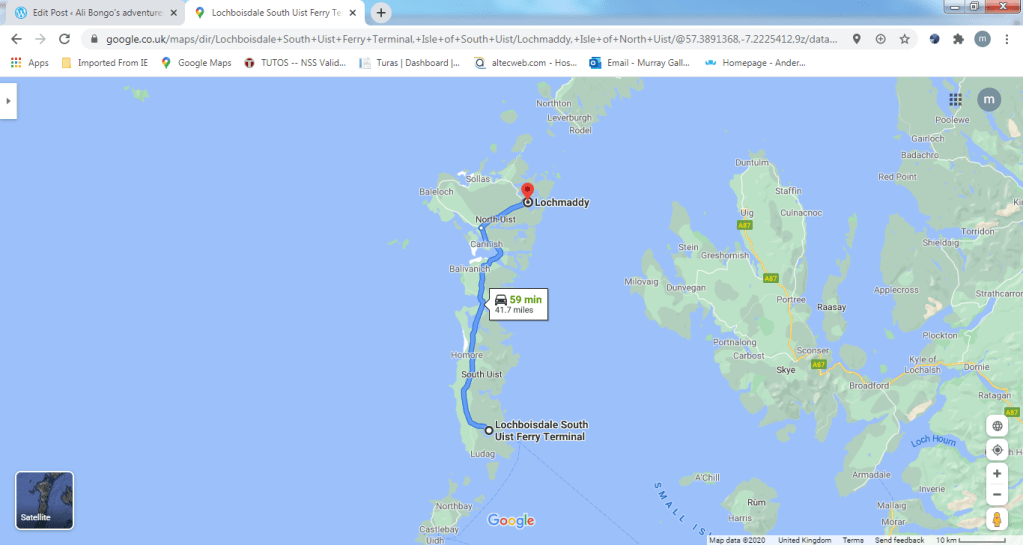
The low angle of the sun was telling me that my “mad crazy” plan to tick off another two islands was perhaps a bit rash. It was only 41miles from top to bottom, but the narrow roads and twisting route had taken about 75 minutes, and we had to travel al the way back again to reach our stop for the night. Well, nothing else for it but to head off.

Sometimes Google maps underestimates the travel time. Worth bearing in mind!
The low autumn sun was sinking fast as we headed north and west again to Balranald

We reached the turning for the north west of the island of North Uist eventually, and not a minute too soon. In fact, it was almost totally dark when we did arrive at Balranald campsite, set behind the high grass dune above a secluded “secret bay” in the Balranald Nature Reserve. The friendly receptionist pointed out our pitch, and we smoothly, even expertly, set the van up on the pitch. Roof up. EHU cable connected. Passenger seat swivelled. Driver’s seat forward to accomodate the kitchen pod. Electrics plugged in, charger set to boost. Water container filled, kettle and heater set up and switched on. dinner sorted out, kettle on. We were getting slick, only took about 10 minutes on arrival to convert to “site mode.” we tucked in to our meal, watched an old movie, then turned in. It had been a long day, and I was annoyed at myself for taking on too much, trying to be clever and ticking off islands. The Milky Way was just stunning that night, in the pitch black skies, and with the wading birds calling sadly to one another in the dark, the faint sound of the sea on the shore, unseen in the black, it really felt remote, wild, and untamed.

Sunrise revealed what a gem of a setting this campsite really was. Toward the sunrise, the low hills stretched east and the gentle fresh breeze off the sea drew me up the grassy slope for a look west….. Wow!

Incredible beaches, unspoilt wild dunes, abundant bird life. North Uist is beautiful!

We showered, ate breakfast, then packed up for the road again. This was the cheapest site we stayed at on this trip, probably due to it’s remote location, but it was certainly the most incredible spot. We will definitely be back to this part of the Outer Hebrides, and spend more than a few hours looking around. But, we had a ferry booked once again, albeit with a later check in time of 1430 latest, so we set off, parking often to walk along the beaches, miles of untouched white sparkling sand, with the greenest seas and bluest skies. Photographs just don’t do justice to the feast for the eyes, as the “smart” camera in my phone tries to fix the light levels, but I snapped away regardless!

Not a bad view, from your front door if you live here!

We reached the Co op at Sollas, and stocked up on snacks and drinks again, plus picked out a few items for lunch, then found yet another vast stretch of beach to sit and eat. So huge was this particular beach, that although there were 6 or 7 cars parked in the little car park, we couldn’t see a single person, until about 20 minutes later a solitary dog walker appeared from the north, followed ten minutes later by a couple on mountain bikes who had been exploring west beyond what was visible from where we sat. I have never seen such wide and beautiful beaches. The images will live with me for a long time. Still we dragged ourselves back to the van, and set off once more toward what was technically yet another island, Berneray, where we would catch the ferry for Leverburgh on Harris. We reached the causeway after a while, headed over, and carried on a bit further to reach another view point. We gazed over the empty landscape, before heading back to the ferry terminal we had passed. we joined the queue at the unmanned terminal, and got out for a wander.

Berneray ferry terminal looking back from the breakwater. Cloudless skies, but a chill breeze off the sea.

We decided to make a cuppa, so I got the gas stove out, for what turned out to be the only useage of the trip. I brewed up, poured into our thermal mugs, then rejoined Lorraine in the front. It was very pleasant in the sun behind the glass, and we listened to the stereo while we sat. After a while, the ferry docked, and we began to board quickly. There were now plenty of vehicles waiting, and we spotted some of the same hire motor homes we had seen each day of our trip. Yet another sailing we had to remain in the van, and it was a very comfortable crossing. If the ship appeared to have to weave to enter Lochmaddy harbour, then this was like an obstacle course! The little ferry turned this way, then that as the helmsman threaded his way through the countless small isles strewn across the sea between Berneray and Leverburgh. I am certain if the sailing were “as the crow flies”, it would be completed in half the time. we caught glimpses of the islands we passed through the gap in the supporting structure for the deck above us, and it would have been incredible to see properly. we will just have to come back, I suppose!

We reached Leverburgh on schedule, and set off on the main road, keen to reach Lickisto, our destination for that night. We took the time to stop a few times though, and the scenery was quite different from the low lying and windswept landscape of North Uist. This had everything, mountains, rugged rocky coastal cliffs, interspersed with silver sandy beaches. The low angle of the sun made everything sparkle, just amazing sights.

The varied landscape of Harris

We reached the minor road turnoff for Lickisto, which wound intricately around the narrow inlets of the east coast of this part of the island. I have never visited Norway, but this is how I imagine it to look, and even some of the buildings we encountered – remote, cladding painted bright yellow, or blue, or orange – looked Scandinavian. we arrived in time at Lickisto Blackhouse campsite, and checked in. The owner, an Ulsterman, was genuinely friendly, and showed us around his site with obvious pride in his facilities. And rightly so. The two restored blackhouses on the croft have the toilet facilities and chillout rooms, kitchen facilities, laundry, everything you might need during your stay. We toured the the tent pitches, little discreet secluded pitches among to greenery, and headed to the loch shore, where he has a secluded harbour and a view down the loch. The sea was glassy still, and the only sounds were the birds down the coast. I watched the sun set from this vantage point after we had set up before climbing the path back to the higher gravel camper pitches nearer the road.

The little private harbour at Lickisto
Our pitch.
Beautifully restored blackhouse, campers facilities, chillout room and laundry.

If Balranald had felt like the far west, then Lickisto was feeling very much like we were a long way north. Perhaps the rugged shoreline, twisting single track roads and lonely crofts set against the hillsides, with the sheltered peaceful inlets helped create a Scandinavian vibe, but it still felt very welcoming and as the other occupants arrived and pitched up, the starry skies we were becoming accustomed to being treated to were revealed. We had been promised the prospect of a glimpse of the Northern Lights, if we waited up, but all the fresh air we got during the day, and the warm and welcoming interior of the Bongo, had us turning in before we had the chance to see it. we had been really lucky with the weather so far, and only somew showers during the day of our drive over Skye had stopped us getting out whenever we pleased. The night skies we were treated to were just awesome though, countless stars, so much brighter than at home due to how dark the skies were. we had no ferry to catch the next day, so there was no pressure to be anywhere, and we felt it was going to be another cracking day ahead!

We closed the blinds, and turned in, looking forward to another day of discovery.

The Road to the Isles – Day Two

Day one saw us travel from home to the beautiful unspoilt beaches of Arisaig, near Mallaig, where we would catch the ferry to Armadale on Skye. The drizzle of last night was intermittent, but light, although the stiff northerly breeze was chilly. As we sorted out a cuppa and tucked into a breakfast muffin, I stuck the diesel heater on for an hour. Within ten minutes, it was lovely and toasty in the van, and the condensation was evaporating off the windows.

This is really unavoidable when you sleep in a small campervan, and two adults produce a few litres of moisture overnight, which has to go somewhere, and the single pane of glass behind the thermal screen is the coldest surface available. We use thermal screens on rear, door and windscreen glass, with just the factory blinds on the side windows. I leave the front door windows open an inch, as with the wind deflectors no rain can enter. This helps a bit with air changes and if not very cold I would normally leave a couple of side windows open too. It was a bit chilly though, so these were all tightly shut. After half an hour though, only the most stubborn condensation on the tailgate window remained, as the heat from the little diesel heater did the job, spreading warm air and pushing the moisture out the open windows. After a quick shower, we packed up and bunged the bedding back under the seat back, re-placing the kitchen pod on the main floor behind the driver’s seat and dropped the roof.

We were off!

Blue skies breaking through the showers in Mallaig, where the bigger ferry bound for the Inner Isles of Rum and Eigg

Mallaig was a lot quieter than when I last visited, last summer, although there were a fair few motorhomes and campervans parked along the esplanade car park. We found a space, and set off on a wander around the shop fronts and cafes, in search of somewhere for a bit of breakfast. I had visited the ferry terminal to confirm we were indeed booked on, and we could check in as soon as the bigger ferry left for Rum. We therefore had a couple of hours to kill, and had set to exploring. The town wasn’t quite the bustling tourist spot it was pre Covid, and a good number of the shops, as well as some of the cafes were closed, sadly. The stiff northerly breeze and occasional drizzle certainly didn’t help to improve the town’s appeal! There was some cheer to be had though, and as we walked round the bay, some of the residents were entering in a scarecrow competition, and some quite ingenious efforts were on display. Our favourite was the characters from the Wizard of Oz.

“Follow the Yellow brick Road!”… to the Western isles! This was our hands-down winner.

We had a lovely hot breakfast roll and cuppa in the Tea Garden tea room, and the owner was lighting the log fire next to our table – lovely! It’s strange how quickly we have got used to signing in, leaving a mobile number and having our temperature taken, isn’t it?! We finished up, and walked back along the esplanade to the van, before driving back and checking in for the ferry. We were in plenty of time, but others were even keener, and as time passed, the lanes started to fill up. The ferry rounded the pier bang on time, quickly disembarked it’s passengers and vehicles, and started to board. As we had suspected, this would be a “remain in your vehicles” sailing too. Such a pity, as the views across the Sound of Sleat are stunning (I had taken this very sailing nearly three years ago with my eldest son), yet another sign of the times we live in. There was a fair chop to deal with and the little ship was rocking and rolling as she crossed the Sound. The sailing takes around 45 minutes, and passed without incident, until we caught our first glimpses of the Cuillin above the boarding ramp. The skipper deftly docked the ship, and we disembarked on probably Scotland’s most popular island, near the southern end at Armadale. We drove off, and found a layby to stop for a stretch.

The road out of Armadale, heading for Broadford in the heart of Skye. The mountains of the mainland on the right.

Sunshine and showers were going to be the theme for today, but the stunning scenery of Skye is impressive in any weather. The mighty Cuillin were before us, as we headed north towards Broadford in the centre of the island, after where we would head to Sligachan before forking left and head up the west coast to our destination for the night in Dunvegan at Kinloch Campsite. Broadford is an ideal place to stop too, there is a decent sized Co-op there, as well as a large filling station. As it was, we had only travelled about 80 miles since Fort William, but we did browse the shelves in the shop, buying some snacks and drinks for later on. We set off again, reached Sligachan, the turning onto the A863 for Dunvegan and the west of the island. This road winds uphill to a fair height, and snakes to the head of a couple of dramatic valleys, one in particular has a spectacular waterfall which I stopped to photograph.

Wild, rugged landscape of Skye.

The showers were coming thick and fast now, and heavier too, but it wasn’t dampening the mood in Ali Bongo – we were firmly in holiday mode now! We had last been to Skye together over 25 years ago, using a borrowed trailer tent, and staying at Kinloch where we were headed! We were excited to revisit, and see if we recognised the place. Just about 100 miles for the day, as we pulled into Dunvegan. located the campsite, and drove the length of the single street to reminisce. There were a few people around, but the campsite was really busy as we checked in – considering the restrictions we were under, it appeared everyone who, like us, had booked up a holiday, had decided to take it. What was very obvious was the number of hire vehicles, motor homes and campervans of all shapes and sizes. Another side effect of the European travel restrictions of this year was the huge growth in these hire companies, and hopefully people who are new to campervanning follow best practice. “Take nothing but photographs and memories. Leave nothing but tyre tracks and footprints.” Our incredible countryside is precious, and I do everything I can to ensure anyone visiting the places we have been can’t tell they aren’t the first person to be there.

Parked up at Kinloch campsite, Dunvegan. Cold, windy and showery.

It was pretty windy when we arrived at Kinloch, but I pitched up with the back of the van into the wind, and we raised the pop top tentatively. The main roof was shielding the more delicate tent from the worst of the wind and rain, and as it turned out, we left it up all night, as we did every night of the holiday. If brand new, then it wouldn’t be an issue, but our old Bongo is fully 25 years old, as is the roof tent, and I didn’t want to put it under any stress. It was fine though, and we stuck the diesel heater on while we sorted out the interior and electric hookup, got the kettle on, and debated going for a walk back toward the village. While we drank our cuppa, the decision was taken for us…the heavens opened! It was a proper downpour, and the wind wasn’t showing any sign of abating either. Well, we had our dehydrated meals to choose from, plus snacks and drinks, so we got comfortable, fitted the thermal screens to the windows and chose a film for the evening. The rain did stop around 10pm, and the clear skies showed a panorama of the Milky Way, the closer planets in full view too. The convector heater would be staying on tonight! We turned in for the night, looking forward to seeing the Outer Hebrides for the first time, sailing from Uig to Lochmaddie tomorrow afternoon.

Dunvegan viewed from Kinloch campsite, the sun shining after the rains of the previous day.

A pleasant surprise awaited us next morning. The wind had dropped a good deal, and clear skies allowed the warmth of the autumn sunshine to flood the van as we removed the window covers. The campsite had a snack wagon on site, and it would be rude not to indulge in a breakfast roll when the nice man had gone to all that trouble! It went well with a coffee too, before we packed up for the day ahead. We would wander over the hills to the port of Uig some 30 miles away. The check in for the ferry to North Uist was from 12pm, so we had a couple of hours to explore. The trip was going well so far, facilities on the campsites were clean, and the ferry bookings had worked out too.

Here’s hoping this would continue!

we completed the packing, and headed off for a last look round Dunvegan before heading toward Uig.

A last look to Dunvegan Loch and the western hills before setting off for North Uist.
The Cuillin
Bongo on the loose!

The Road to the Isles – Day One

Incredible beaches, rugged coastlines, dramatic skylines, vast moorland. The Outer hebrides has it all!! Arisaig beach.

This has been a strange year so far. March brought the Lockdown, and travel restrictions prevented any leisure travel in Scotland. July brought limited travel, and a short trip to Moffat was essentially our summer holiday. Further restrictions and poor weather put paid to pretty much everything else, so with determination to get something memorable for the right reasons, rather than life revolving round Covid 19, I resolved to plan a trip for October, and hope for the best! It would be ambitious, and require careful planning to make it work (if we would be able to travel!) but this year was a bit of a milestone for Lorraine and I, being our 25th anniversary, and it was really important to me that we would have something positive to remember.

So, I started to put together the plan for an Island Hop trip to the Outer Hebrides.

This would have to work to coincide with half term in October, which was increasingly risky, as a further lockdown, or “Circuit Breaker” was being threatened, but I felt confident that if cancelled I should be able to get refunds on at least the ferry tickets, and the trip was worth some degree of risk. I reckoned we had a window of seven days for the trip, allowing for a day to prepare, and a day to unpack and get ready to return to work. I set to work.

Leaving Skye and Uig harbour, headed to Lochmaddie, North Uist, on a gloriously sunny day.

So, how much could I fit into a week? Well, I had an ambitious plan to try and catch a ferry nearly every day, visiting a different island for every day, if not each day at least. The potential issues were around catching ferries when often there were few sailings each day, but still have at least long enough to get a look around each place we visited. While some of these visits ended up merely driving through, for the most part I was content that we got the flavour of our destinations, and it certainly whetted the appetite for returning next year!

DAY ONE – Home to Arisaig (Mallaig) FERRY ONE – McInroy’s Point to Hunter’s Quay

We’re off!! McInroy’s Point, Gourock, to Hunter’s Quay, Dunoon, on Western ferry

With the van packed, and armed with a thick folder of booking confirmations and ferry timetables, we set off on a Sunday morning from home, via the filling station, up the coast on the A78 toward Gourock and our first ferry, the Western ferry from McInroy’s Point across the Firth of Clyde to Argyll and Hunter’s Quay near Dunoon. We had tickets, however the ferry company don’t allow pre booking of crossings, so there was a little apprehension as to whether we would get on the next sailing. We did, though, and although the Clyde was a little choppy, the sailing was uneventful. It’s a great pity that the current restrictions meant that we couldn’t get out the van for a look at the beautiful scenery, merely catching glimpses above the gunwhale of sky and eventually the far shore. we disembarked, and stopped to stretch the legs after sitting for such a long time. The sun was shining on us, and the quiet roads and views of the Arrochar Alps to the north made us both feel like we were finally on our way. I had chosen to drive this route via this ferry crossing as a change from the familiar, always busy route past Loch Lomond to the Western Highlands, and as we travelled up the winding road to Inveraray, it felt like a good plan! What breathtaking scenery, and so close to where we live! What an incredible part of Scotland this is. As we arrived in Inveraray, it was around 12pm, and it felt like time for a decent stop, a walk around, and a spot of lunch.

Inveraray, Argyll

The town was pretty busy, considering the official guidance on travel, but nowhere near how busy it normally is at half term. People strolling in the sun, eating ice cream, drinking coffee, and relaxing. We had parked in the large car park behind the main street, and we walked down to use the toilets and found a bench to sit and eat lunch. This was nice!

The road approaching Inveraray

Eager to continue travelling, we walked back to the van and set off. I had chosen the A819, toward Dalmally and Loch Awe, where we would regain the main A85 road for Fort William. Over the hills to Cladich we saw only a handful of other cars and vans. The A85 was a bit busier, but not enough to impede progress, and the Bongo was in it’s element on these winding roads. The views were stunning as we went, and the houses along Loch Eck, and Loch Awe were beautiful. There were certainly a good number of motor homes and campervans on the roads, as people were desperately trying to get some time away from home and the stress and depression of Covid restrictions. On we travelled, crossing the bridge at Connel. We drove up the A828, past Appin, to Ballachulish and over the bridge at the mouth of Loch Leven, on to the more familiar road to Fort William, the A82. As we crossed the bridge, the road was visibly busier than the A828, and I looked for somewhere to pull in for another leg stretch. The terminal for the Corran ferry was reached, and we got there in time to watch this strange little ship arrive and unload. Strange, as the car deck ramps sit on an angle, unusually, to allow the ship to dock upstream of the ramp without tether. Quite ingenious, but strange looking none the less!

The strange looking Corran ferry

We pressed on to Fort William, where I made to top up the fuel at the filling station. 140 miles, for around 18.5 litres? Brilliant, and equating to around 34 mpg. Ther was a chill in the damp air, and grey skies now, as we headed north and west from the town, eager for our first campsite and a well earned cuppa, as well as dinner! The drive toward Mallaig is always stunning, with the beaches glimpsed between the pines edging teh sheltered sea lochs, and of course the stunning railway viaduct made famous by the Harry Potter films, the Glenfinnan Viaduct. Looking down the atmospheric Loch Sheil invokes the scenes from the films when Hogwart’s is seen, courtesy of some brilliant CGI.

Eventually, we reached the turn off for Arisaig, where we were headed, and Camusdarach Campsite. There are several campsites along the Arisaig peninsula, and with good reason, the scenery was incredible. We arrived at the entrance, and checked in for our first overnight. The owner was very friendly, and first impressions were that they were well prepared for the restrictions imposed on us currently. The spacious level pitch allotted us was on a quiet part of the site, a short walk from the toilet block, but close to the beach access. I got the Bongo parked, roof up, plugged in and kettle on in short order. The new kitchen pod being premiered was so far working out nicely, and was soon situated where it would live while pitched up. After that cuppa, we walked down to the beach. Wow! Absolutely breathtaking beach, with views over the Sound of Sleat to Skye.

Heading down to the beach
Incredible beaches
The Rum Cuillin and high plateau of Eigg across the Sound of Sleat

We walked back by way of the road to our van and sorted out dinner, a dram, and a movie for the evening. On the way we bumped into a fellow Bongo owner, a young couple from Edinburgh on a trip around the country. We exchanged greetings, then left them to eat their tasty looking meal before tucking into our own. We pulled out the bed, and turned in for the night, looking forward to spending a few hours in Mallaig in the morning prior to catching the ferry to Armadale on Skye. A light drizzle set in for the night, but we were warm and cozy in the Bongo.

Our Island adventure was about to begin!

Galloway Forest weekend adventure

Not a bad view from Bruce’s Stone, Loch Trool

Desperate to cram as much into our new-found return to freedom, my eldest son and I made a foray into the Galloway Forest Park back in mid-July, and over the weekend got some wild camping in the Bongo and a cracking hillwalk too. The Park was really busy, alive with campers and campervanners, motorhomes and even folk camping in cars! Driving up past Loch Doon proved that pretty much anywhere that a van would fit, already had one parked up! This would call for some exploring – something the Bongo is ideal for.

So, we retraced our steps back to the main road, then headed in the direction of Straiton, a little village nestled in the hills between Dalmellington and Maybole. Arriving at the village, we headed inot the dark Sky Park in the direction of Newton Stewart. I had been this way before exploring, you might remember, and I knew there were bound to be possibilities down some of the forestry roads. We turned off into the forest, and after a half hour or so came upon a spot I had made mental note of previously. Ideal! A wee turnaround for the forestry trucks, made for a perfect spot, and utilising the newly purchased levelling ramps got the van sitting nicely. I stuck the roof up, and we explored on foot around the tracks.

Parked up, levelled off, roof up. next job, dinner!!

We ate dinner, watched a movie on the DVD player, and turned in, as we had a busy day planned tomorrow! The intention was to climb Corserine and the Rhinns of Kells, a hike of over 11 miles and 900 metres of ascent.

We woke early enough, breakfasted on a couple of Summit to Eat ready meals, packed up and headed to the car park in the Fred Olsen estate where the route up the ridge starts from.

A happy camper – breakfast is ready!

The weather was fair, and starting to heat up a bit, at least at low level. We packed our bags and set off, keen to gain some height and escape the midges that were starting to prowl. There were also swarms of flies, which didn’t seem to bite, but bumped into you repeatedly, and sought out ears, noses, necks and anywhere they could really irritate!! The walk through the forest was otherwise stunning, but we couldn’t bear to slow to admire the views too much. We started up out of the forest, following the path which became fainter as we ascended, and made good progress despite it being a long time since anything this strenuous had been tackled. The views back were amazing, and well worth the climb.

Views from Corserine, stunning countryside.

We summited Corserine in good time, and although the cloud was around us to begin with, this cleared to allow some tremendous views back over the lochs, hills and forestry all around. We continued along the ridge, more a grassy mound, to complete the Rhinns of Kells, down into a bealach, past the lochans there, and climbing back to the summit of Meikle Millyea, before descending wearily down the steep slopes, picking our way down rocky steps to regain the forest trails and back to the van. 6 hours after we set out, we regained the car park, stripped off the boots, had a drink and a salty snack, before starting out along the road to Glen Trool, and Bruce’s Stone above Loch Trool. The viewpoint car park was busy, but I found a spot to park, and we walked the short distance to where the stone is set, with a panorama of the loch behind.

Bruce’s Stone, Loch Trool

We got back in Ali Bongo, and headed further south until we reached a junction in the road where we turned for Girvan, down the scenic A714. I really enjoy this road, and as always the Bongo just feels in it’s element along twisty A roads, so relaxing to drive the auto box and the van was pulling well. We reached the main A77 at Girvan, turned for Ayr and the road home. We had crammed an overnight, and a hillwalk into just 24 hours, and the Bongo showed it’s versatility yet again, a perfect vehicle for adventures, a superb base for exploring the hills and forest trails, a comfy camper and capable vehicle too.

Water of Trool, swollen with rain water.

Can’t wait for more Bongo adventures!

Design a site like this with WordPress.com
Get started